

There is a specific kind of quiet panic that happens right before you hit "send" on a pricing update email.
You’ve looked at the numbers, evaluated your current capacity, and acknowledged that it is time to realign things. Yet, staring at the screen, an epic flood of doubt rushes in. Knowing how to tell clients about a price increase is rarely a simple mechanical challenge (if only it was that easy!), but almost always an internal psychological boundary that forces us to face our deepest fears of conflict, rejection, and client abandonment.
If you are currently second-guessing your value, navigating this transition can feel pretty isolating. But the truth is, even experienced business coaches go through this exact same thing.
In January, I did something I hadn't done in eleven years of running my practice:
I restructured and raised my coaching rates.
My personal tipping point arrived with a major life transition. I moved overseas to Ireland, which marked a new chapter for both my life and my business footprint. Because I was converting my pricing into Euros anyway, the pivot invited me to take an honest look at the overall value of my work. My business was sitting at a full roster, I was actively teaching in a coaching certification course, and I had earned two distinct coaching certifications. The data and my experience clearly supported the adjustment. It was time.
Yet, even with over a decade of experience coaching other entrepreneurs through their own visibility barriers and pricing blocks, the night before I sent those emails, the old familiar hesitation still sat in the room with me. This is a good place to remind people that, as a coach, we still experience these moments. But there is a way of working through them.
The Real Reason Raising Your Rates Triggers Second-Guessing
When we face the prospect of increasing your fees, a very specific, protective part of our psychology goes on high alert. For service providers who deeply value relationship dynamics, the underlying worry usually sounds something like, "But if we price higher, we’ll price ourselves out of helping the very people we love to work with."
It is an incredibly common pattern. We convince ourselves that if we step into our actual value, we will alienate our established niche or push away the clients who have grown with us.
It helps to recognize this worry for exactly what it is: a protective instinct doing its best to keep you safe from perceived psychological risks like disappointing someone you respect, facing a tense conflict, or losing a long-term relationship.
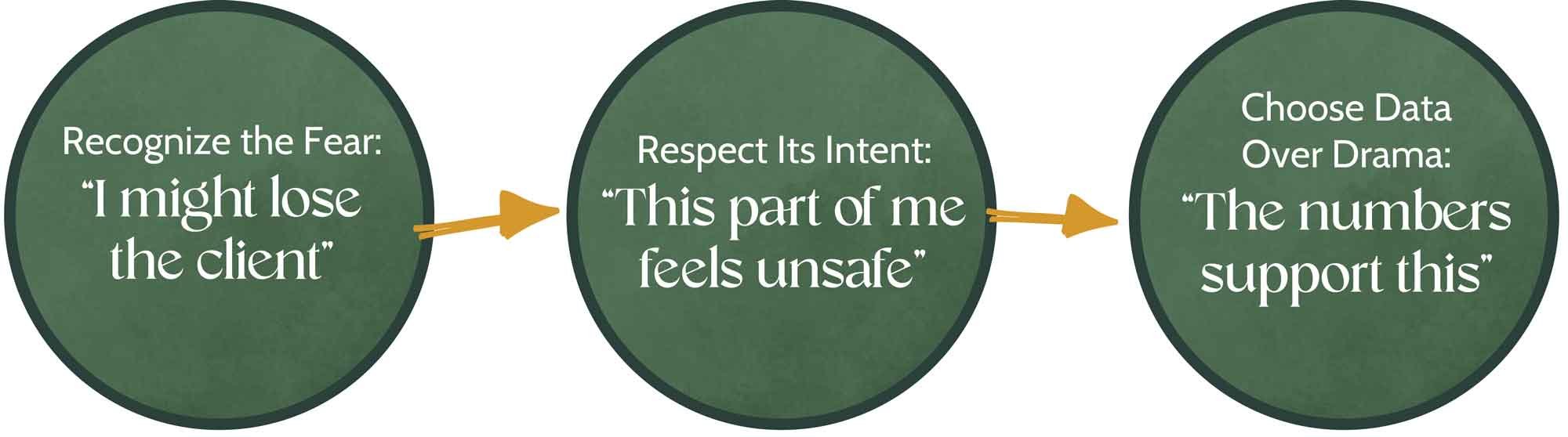
When I was drafting my own pricing announcements in January, I felt that exact protective mechanism trying to negotiate against me. Instead of leaving that voice on the side of the road or trying to bypass it with cold logic, I respected it. I acknowledged that it had a job to do. But I also knew that a protective part of your brain cannot be what runs your business operations. Because, when it does (and I know this from all of my work and have seen it time and time again), it has only one goal in mind: wait.

How to Increase Pricing to Clients Without Them Leaving
To safely execute a pricing upgrade without triggering an existential crisis, I’ve found it’s critical to learn how to support yourself through the transition. You can respect your internal need for safety while simultaneously taking bold, necessary steps for your business growth.
When I adjusted my rates, I chose to thread the needle. I didn't issue an aggressive, overnight decree. Instead, I gave my existing network ample time to bank future coaching sessions at their legacy rate if they wished to do so.
This small operational buffer serves two critical purposes:
For Your Clients: It demonstrates deep respect for their loyalty and allows them to adjust their own financial planning smoothly.
For Your Nervous System: It satisfies that internal protector. It softens the immediate fear of conflict because you are offering a generous, warm bridge into the new tier.
By presenting clear options and distinct time horizons, you remove the artificial high-stakes drama from the equation. You allow the transition to become a transparent, mutual conversation about expectations, rather than a rigid baseline test of your worth.
How to Handle Client Pushback on a Price Increase
What happens when you finally send the emails and open your inbox the next morning? Well, firstly, you often assume the worst case scenario of a wave of angry exits and pushback.
But when my emails went out in January, the reality of the inbox provided a beautiful piece of new evidence.
There was no anger. There was virtually no pushback (A single client asked to extend the grace period. I gratefully said yes). Instead, what actually occurred was a collective shrug.
In fact, one of my longest, most valued clients replied with a sentence that instantly dismantled my entire internal worry: "You're worth every penny."

This is what helps us shift into what I call Operational Neutrality (popularly known as “no big deal”). When you stop looking at pricing as a measure of your personal acceptability or self-worth and start treating it purely as a resource metric, the anxiety shrinks down to its appropriate size.
When you state your parameters clearly, warmly, and neutrally, the vast majority of your ideal clients will simply say, "Yeah, sure, sounds good." And for those who do choose to step away because it no longer aligns with their ecosystem? You can handle that situation with maturity, help them transition responsibly, and trust that you can support yourself through the completion of that relationship. You may also consider a short-term compromise if it feels appropriate. Or not! Trusting yourself to know what is best is central to this. The truth is, not every client is supposed to be with us for our entire journey in our businesses. It’s worth knowing when it’s time to stop working with a client that doesn’t align.

Own Your Value and Stop Undercharging
If your current calendar is overflowing with scope creep, over-delivering, and exhaustion, it is a glaring indicator that your business frameworks have outgrown your current pricing boundaries. Continuing to operate at an artificially low pricing floor out of a fear of looking foolish or losing approval is a fast track to severe business burnout cycles.
Stepping fully into the positioning and brand you’ve built can sometimes require a real willingness to sit with the uncomfortable decisions that growth demands of us.
Another thing to consider is that you may not need to increase your prices at all. You can clear up your back-billing. Audit your current contracts for hidden, uncharged labor and scope creep. Adjust your intake parameters.
Once you realize that you can survive the boundaries you set, your relationship with your business may change. The work simply becomes the work. A contract becomes a clear set of expectations. A price increase becomes a natural operational evolution. No drama. No big deal.
Reclaiming Alignment
The patterns we use to cope with business overwhelm, pricing friction, and visibility anxiety are deeply tied to our core entrepreneurial wiring. If you are ready to identify the specific mental models that are secretly running your business and keeping you stuck on a performance merry-go-round, take the free Adaptotype Quiz. In less than five minutes, you will diagnose your primary adapting style and unlock a clear path toward sustainable growth.
If you are an established consultant or practitioner navigating a major business pivot, rebranding, or pricing transition, let's establish your new operational baseline together. Explore the One-on-One Coaching Series to design a tailored, practical action plan that allows you to lead your business with absolute clarity, courage, and self-trust.